
You’ve noticed the signs. Maybe Mom grips the towel bar when she steps out of the tub, or Dad mentioned a close call on the wet tile last winter. You know it’s time to talk about bathroom safety—but every time you rehearse the conversation, it sounds like you’re telling your parents they’re old.
You’re not alone in this hesitation. For most adult children, the hardest part of helping aging parents stay safe at home isn’t finding the right products or hiring the right contractor. It’s starting the conversation.
The good news is that, with the right framing, this discussion doesn’t have to feel like an intervention. It can feel like what it actually is—an act of love and a smart home investment. Here’s how to approach it.
Why This Conversation Feels So Hard
Before you can have a productive talk, it helps to understand what’s really going on beneath the surface—for both of you.
For your parents, resistance to bathroom modifications usually isn’t about the products themselves. It’s about identity. The National Institute on Aging notes that more than one in four people age 65 or older fall each year—but many older adults don’t see themselves in that statistic. Accepting grab bars or a walk-in shower can feel, to them, like admitting decline. Psychologists call this identity protection, and it’s one of the most powerful forces in human decision-making.
For you, the discomfort often comes from role reversal. Raising safety concerns with the people who raised you can feel presumptuous, even disrespectful. Many adult children avoid the topic for months or years—not because they don’t care, but because they care so much that they fear getting it wrong.
Here’s the reframe that changes everything: this conversation isn’t about age. It’s about independence. Every suggestion you make should flow from that single idea.
Timing Matters: When to Bring It Up
The worst time to discuss bathroom safety is immediately after a fall, when emotions are high and your parent may feel defensive or frightened. The best time is before anything happens, when the conversation can be calm, forward-looking, and free of urgency.
Good moments to start the conversation include:
- During a home improvement project. If your parents are already updating their kitchen or replacing flooring, bathroom upgrades fit naturally into the discussion.
- When a friend or relative has a fall. A story about someone else creates distance: “Did you hear about Carol’s fall? It got me thinking about how we could make your bathroom safer—and honestly nicer—at the same time.”
- While planning for the future together. Conversations about retirement, travel, or staying in the family home open the door: “If you want to stay in this house for the next twenty years, let’s make sure it’s set up for that.”
- When you’re updating your own home. Leading by example removes stigma entirely: “We’re adding a curbless shower in our remodel—they look amazing now. You should see the designs.”
Seven Ways to Frame the Conversation Positively
The words you choose matter enormously. The same product can sound clinical or luxurious depending on how you describe it. Here are seven proven framing strategies:
1. Lead with design, not decline
Today’s bathroom safety products bear little resemblance to the institutional equipment your parents may be picturing. Modern grab bars come in brushed nickel, matte black, and oil-rubbed bronze finishes that look like high-end towel bars. Curbless showers are a staple of luxury hotels and design magazines. Start there: “Have you seen what spa bathrooms look like now? Zero-threshold showers are the most requested feature in bathroom remodels.”
2. Talk about “planning ahead,” not “needing help”
Smart people plan. Your parents likely planned for retirement, planned their estate, and planned for your education. Position bathroom modifications as the same kind of foresight: “You’ve always been ahead of the curve. Updating the bathroom now, on your timeline, beats scrambling to do it later.”
3. Make it about the house, not about them
A home that supports aging in place is a more valuable home, period. Universal design features appeal to buyers of every age. Framing modifications as a property investment removes the personal element entirely: “These upgrades add resale value even if you never need them.”
4. Use “us” and “everyone” language
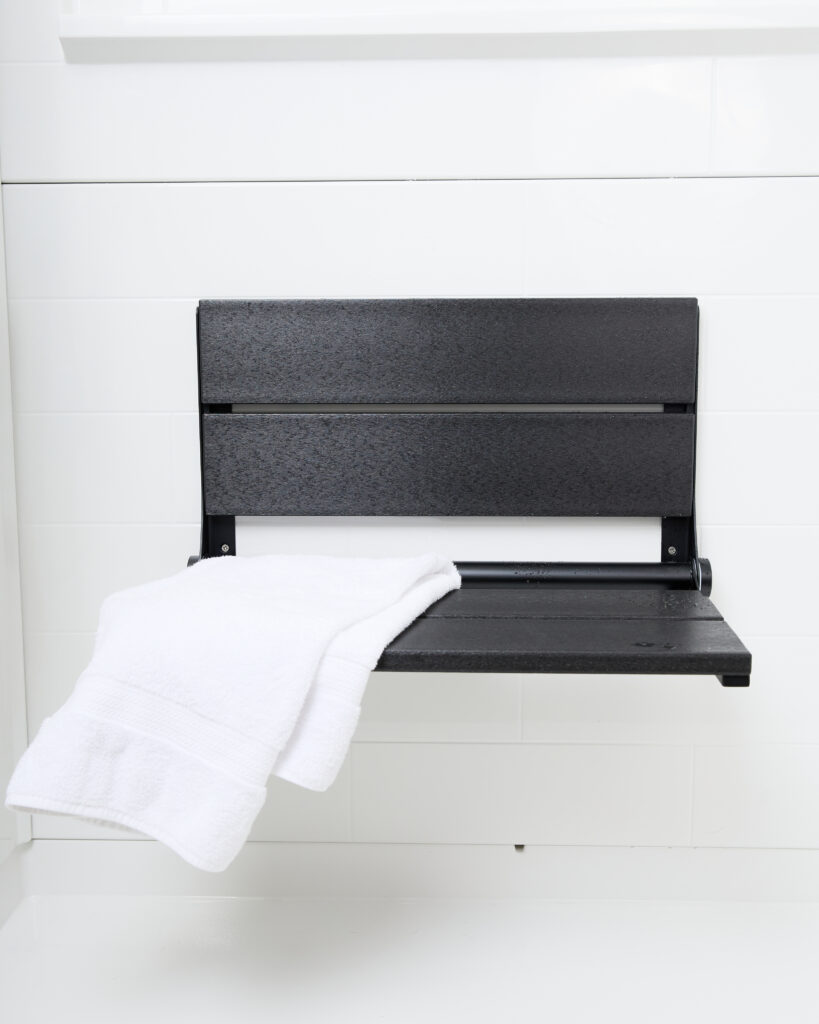
Universal design benefits every member of the family—grandchildren, guests, and you included. “A bench in the shower is great for everyone. I use ours to shave my legs.” Comfort-height toilets, better lighting, and lever faucet handles make life easier at any age.
5. Share the numbers—gently
Some parents respond well to facts. AARP’s 2024 Home and Community Preferences Survey found that 75% of adults 50 and older want to remain in their homes as they age. Your parents are part of a large, growing movement—not an exception. And CDC data shows about 3 million emergency department visits due to falls among older adults each year—a statistic worth mentioning once, without dwelling on it.
6. Give them the driver’s seat
Nothing triggers resistance faster than feeling controlled. Present options, not decisions: “Would you rather start with the shower or the flooring?” Let your parents choose finishes, fixtures, and timing. When they select the matte black grab bar themselves, it becomes their design choice—not your safety mandate.
7. Start small
You don’t need to propose a full remodel on day one. A single well-placed grab bar, brighter lighting, or a non-slip surface treatment is a low-stakes entry point. Small wins build trust and often lead naturally to larger projects: “Let’s just try the one bar by the shower. If you hate how it looks, we’ll take it out.”
What Not to Say
Even well-intentioned words can shut the conversation down. Avoid these common missteps:
- “You’re not getting any younger.” True, but this centers age—exactly what you want to avoid.
- “Before something happens to you…” Fear-based framing puts parents on the defensive.
- “I worry about you all the time.” This can make parents feel like a burden, which often increases resistance rather than reducing it.
- “You need this.” Nobody likes being told what they need. Try “this would be a great upgrade” instead.
- Bringing it up in front of others. A private, unhurried conversation preserves dignity. Group settings can feel like an ambush.
Handling the Most Common Objections
Even with perfect framing, expect some pushback. Here’s how to respond to the objections you’re most likely to hear:
“I don’t need this yet.” “That’s exactly why now is the perfect time. Doing it on your schedule, with the designs you want, is so much better than doing it in a rush later. Most falls happen in homes that felt safe—until they weren’t.”
“Those things look medical and ugly.” “That’s what I thought too, until I saw what’s out there now. Let me show you some photos—these fixtures look like they belong in a boutique hotel.” (Then actually show them. Visuals overcome this objection faster than any argument.)
“It’s too expensive.” “There are options at every budget—some of the most effective upgrades cost a few hundred dollars, not thousands. And compared to the cost of a fall, or of moving to assisted living, it’s one of the best investments you can make in staying right here.”
“I don’t want strangers tearing up my house.” “Most of these upgrades install in under an hour with no renovation at all. And certified installers who specialize in this work treat homes with real care—we can meet them together before anything starts.”
Bring in a Trusted Third Party
Sometimes the message lands better when it doesn’t come from family. Consider enlisting:
- Their doctor or physical therapist. A recommendation from a healthcare professional carries clinical weight without family baggage. Many occupational therapists offer home safety assessments and can make specific, personalized recommendations.
- A CAPS-certified contractor. Certified Aging-in-Place Specialists—credentialed through the National Association of Home Builders—are trained not just in accessible design but in discussing it respectfully. A design consultation feels collaborative, not corrective.
- Friends who’ve already upgraded. If your parents know someone who loves their new walk-in shower, arrange a visit. Peer influence is powerful, and seeing beautiful modifications in a friend’s home normalizes the idea.
After the Conversation: Keep the Momentum Going
One good conversation rarely settles everything—and it doesn’t need to. Your goal for the first talk is simply to open the door. Afterward:
- Follow up with visuals, not pressure. Send a photo of a beautiful curbless shower or a designer grab bar with a low-key note: “This is the kind of thing I meant.”
- Offer to handle the logistics. For busy or overwhelmed parents, “I’ll research the options and find the installer—you just pick the finishes” removes the friction that stalls most projects.
- Set a soft timeline together. “Should we aim to have the shower done before the holidays?” gives the project shape without forcing urgency.
- Celebrate the result. When the project is done, focus on how it looks and feels—not what it prevents. “This bathroom looks incredible” reinforces that they made a design decision, not a concession.
The Conversation Is the Gift
Here’s the truth at the heart of all this: your parents protected you for decades. Making their home safer is one of the most meaningful ways to return that care—and doing it with respect for their independence and dignity makes the gift complete.
The families who navigate this best don’t treat bathroom safety as a difficult topic to survive. They treat it as an ongoing collaboration—one that starts with a single, well-framed conversation and ends with parents who feel more confident, more independent, and more at home than ever.
At Health at Home, Inc, we’ve been helping families have this conversation since 2009. We partner with contractors, remodelers, designers, and healthcare professionals to provide bath modification products that are as beautiful as they are safe—barrier-free, aging-in-place, and spa-inspired spaces that no one has to feel self-conscious about. With over 75 years of combined experience in plumbing fixtures and bath accessibility, we understand that the right products make the conversation easier.
Ready to show your parents what modern bathroom safety looks like? Contact Health at Home, Inc. today to explore design-forward accessibility solutions—and turn a hard conversation into an exciting home upgrade.
Keywords: talking to aging parents about safety, bathroom safety conversation, aging parents bathroom modifications, how to talk to elderly parents, aging in place conversation, senior bathroom safety, grab bars for seniors, walk-in shower for elderly parents, aging in place planning, bathroom modifications for aging parents